What Does a Raleigh Real Estate Agent Actually DO?
What a Raleigh Real Estate Agent Actually Does
And Why It Looked Different the Day
the Appraisal Came In Low
Does every meeting you have start like this? "What do you actually do that another agent wouldn't?"
It's a fair question. The truth is, the answer isn't the same for every client.
Sometimes my value shows up in the marketing—the photography, the advertising strategy, the way a home is positioned to attract the right buyer at the right time. Sometimes it shows up before a home ever hits the market, helping sellers understand exactly where they fit competitively and how buyers are likely to respond.
Sometimes it shows up at the negotiating table.
And sometimes it shows up in a moment nobody sees coming. This is one of those moments.
The Home That Had Everything Going For It
Several years ago, I listed a home that had been beautifully remodeled.The sellers had invested thoughtfully. The details were right. The finishes were right. The home showed exceptionally well and felt move-in ready from the moment buyers walked through the door.
The location was what I would call transitional.
It sat just outside one of the area's hottest up and coming neighborhoods North Hills—close enough to benefit from the momentum, but not yet close enough for the comparable sales to fully reflect where values were heading.
If you've sold real estate long enough, you learn to recognize these areas. You can see where the market is moving before the data catches up.
We launched the listing.
Almost immediately, we received a full-price offer.
Most people would assume that's where the hard part ends.
In reality, sometimes that's where it begins. Then the Appraisal Came In
The appraisal came back significantly below the contract price.
Suddenly, what looked like a smooth transaction wasn't so smooth anymore.
When this happens, most sellers are presented with a short list of options.
1) Lower the price to meet the appraised value.
2) Ask the buyer to bring the additional cash to closing.
3) Ask the Buyer to seek another lender and proceed a second time.
Those are the obvious solutions.
I reviewed the appraisal carefully. While I disagreed with several aspects of it, I also understood something experience has taught me over the years: arguing with an appraisal rarely changes the outcome. And in this case I needed a HUGE change.
Banks almost never move significantly from an appraiser's opinion of value.
So instead of focusing on a battle we were unlikely to win, I focused on a different question:
What if this wasn't the right buyer?
And that's when I made a recommendation most agents wouldn't.
I told my sellers to let the buyer go. CUT THEM LOOSE. . . .
Why Walking Away Made Sense - To be clear, this wasn't a guarantee.
It wasn't a gamble based on hope, either.
It was a calculated decision based on market knowledge, buyer behavior, and what the market had already told us.
A buyer had walked through that front door and willingly offered full price. The same full price I had recommended based on my own research.
I believed the appraisal had failed to fully capture the the quality of the improvements. More importantly, I believed there were likely other buyers who would see the same value the first buyer had seen.
So we relisted the home with a modest pricing adjustment—not a dramatic one, just enough to re-enter the market strategically—and we went back to work.
What happened next wasn't guaranteed. But it worked. We received another offer.
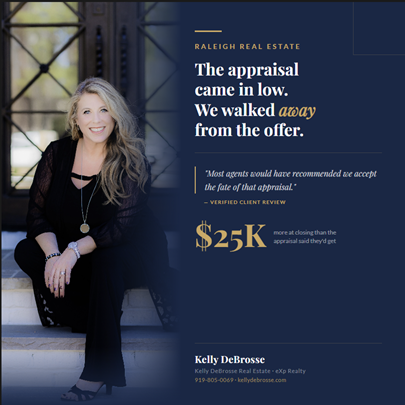
The second appraisal came in without issue. My sellers netted $25,000 more than they would have if they had simply accepted the first appraisal and moved on.
That is Part of the Job Most People Never See. After closing, the sellers left a review that has stayed with me for years.
Part of it read:
"Most agents would have recommended we accept the fate of that appraisal. The real value she brought in this situation was in supporting and outlining the minimal risk we needed to take to ensure the maximum price for our home."
The phrase that stuck with me was accept the fate of that appraisal.
Because that's exactly what many sellers are told to do. Not because agents don't care. Usually becasue they don't know better.
Recommending that someone walk away from any deal is uncomfortable. It requires confidence in your understanding of the market. It requires honest conversations about risk. And it requires being willing to stand behind your advice when there are no guarantees.
The value was understanding that more options existed—and helping my clients see them clearly enough to make an informed decision. I recommend the decision I would make for myself or my family in that circusmtance.
What This Means for Raleigh Sellers Today.
Appraisal gaps still happen.
In fact, they tend to happen most often in exactly the types of neighborhoods that are experiencing growth and transition. They happen when demand moves faster than historical sales data. They happen when buyers recognize value before the spreadsheets do.
Sometimes accepting the appraisal is absolutely the right decision.
Sometimes it isn't.
The difference is having someone in the room who can help you understand the options, evaluate the risks, and determine which path makes the most sense for your situation.
After more than 23 years and over 2,000 transactions across Raleigh and Wake County, I've learned that the most valuable moments in real estate rarely happen when everything goes according to plan.
They happen when something unexpected occurs and someone needs a clear path forward.
That's the part of the job most people never see.
And it's often where experience matters most.
If you're thinking about selling your home in Raleigh, North Raleigh, or anywhere in Wake County and want a realistic conversation about your options, I'd be happy to help.
No pressure. No sales pitch.
Just an honest discussion about your goals, your home, and the strategy that makes the most sense for your needs.

Thinking about your own situation?
Call or text, or send me an email. We can start with a conversation.