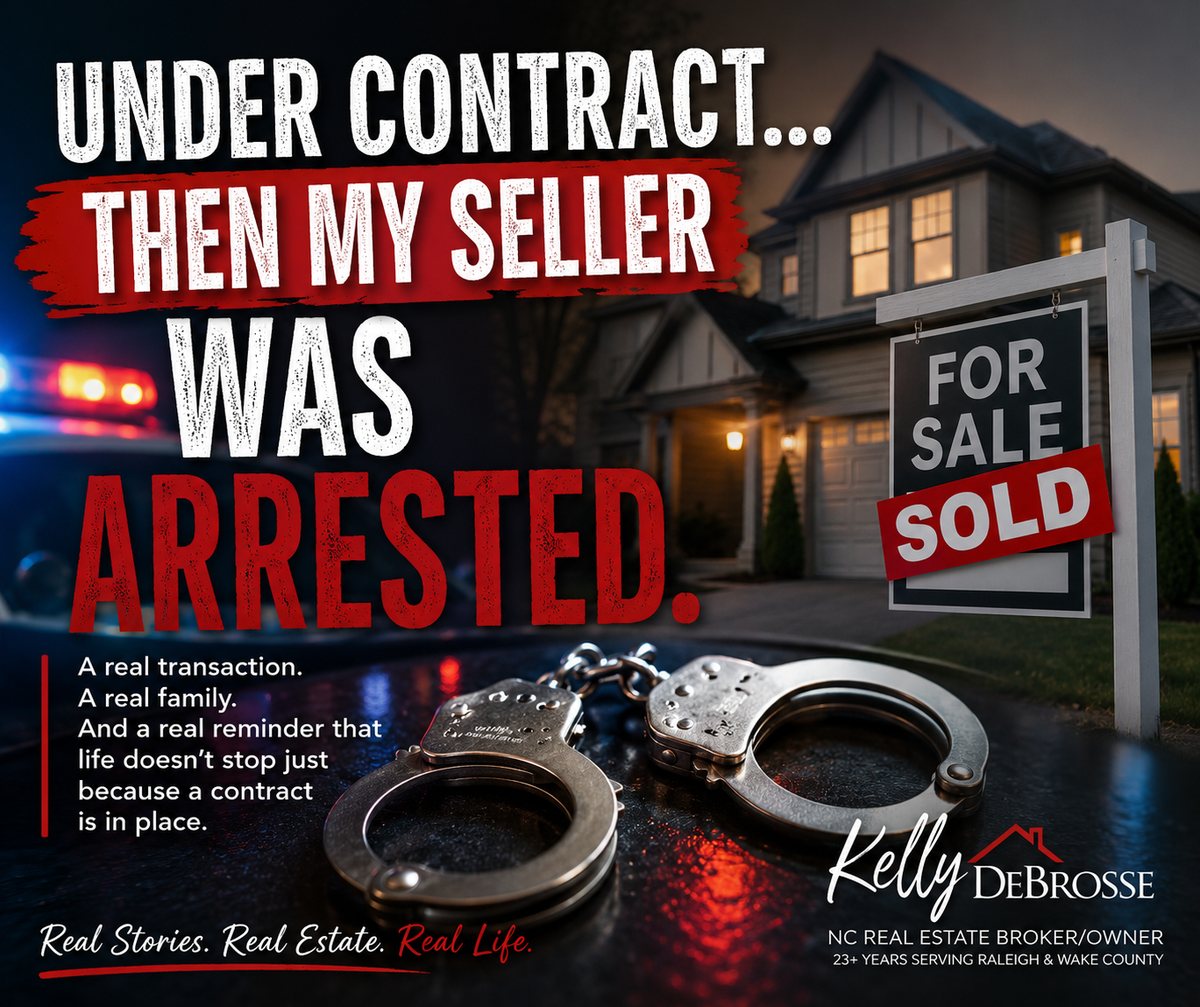
Under Contract . . . Then My Seller Was Arrested
By Kelly DeBrosse | eXp Realty | 23+ years serving Raleigh, Wake & surrounding counties
There are some transactions you remember because of the house, and others you remember because of what happened around the house. This one has stayed with me for years because it became one of those reminders that real estate does not happen in a vacuum. People are buying and selling homes while life is still happening to them, and sometimes life changes everything in the middle of the transaction.
The house itself was already not an easy sale. It had some very specific personalization that worked for the sellers but did not appeal to the majority of buyers, and the driveway was extremely steep, which eliminated another group of buyers almost immediately. It was one of those properties where you knew the right buyer was out there, but you also knew finding them might take some time.
Eventually, we did.
We went under contract with a couple who were expecting a baby, and at that point everyone was moving forward with the expectation that the sale would close. This was also before the due diligence structure we have in North Carolina today, so the contract and the options available to buyers looked different than they do now.
Then, in the middle of the transaction, the husband was arrested.
There was no warning. His wife was completely blindsided, and what followed was absolutely devastating for their family. What had been a difficult home sale suddenly became the smallest part of what they were dealing with, but unfortunately the real estate transaction did not stop just because their lives had been turned upside down.
The husband did not return home. He remained detained and eventually went from jail to prison. Meanwhile, there were still documents that needed to be signed, deadlines that had to be addressed, and decisions that required both sellers.
That meant I had to learn how to navigate something I had certainly never been taught in real estate school.
When documents needed to be signed and notarized, I went to the Raleigh detention center and worked with the staff there to figure out how to get the paperwork handled correctly. I had to understand what was possible, who could help, how signatures could be obtained, and how we could continue moving the transaction forward while one of the sellers was incarcerated.
It was not glamorous. It was not a situation where experience gave me some perfect playbook to follow. It was simply a matter of figuring out what needed to happen next, asking the right questions, finding the right people, and doing everything I could to keep the transaction together while also trying to be sensitive to what this family was going through.
And then the buyers found out what had happened.
I do not remember exactly how the information reached them. It may have been something they saw on television, online, or through another source, but once they learned about the arrest and the circumstances surrounding it, their feelings about the house changed.
Nothing about the physical property had changed. The driveway was the same. The floor plan was the same. The features they liked when they made the offer were still there. But they were expecting a baby, and emotionally they no longer wanted this to be the home where they started that next chapter of their lives.
They described the house as having “bad juju” or “bad karma,” and they terminated the contract.
For the sellers, that was another terrible blow layered on top of everything else they were already dealing with. We had worked through the logistics of getting documents signed while the husband was detained, we had continued trying to protect the transaction, and in the end the first deal still did not make it to closing.
That is an important part of this story, because sometimes in real estate there is no heroic save.
Agents like to talk about the deals we rescued, the negotiations we turned around, and the problems we solved at the last minute. I have plenty of those stories too. But there are also transactions where circumstances outside anyone’s control become bigger than the contract itself.
This was one of them.
The first transaction was over, but the listing was not.
We put the house back on the market and started again. The same challenges were still there. The personalization had not disappeared, the driveway had not become less steep, and now the sellers were dealing with a life situation no one could have anticipated when they first decided to sell.
Eventually, we found another buyer and the home sold.
I think that is one of the lessons I have carried from this transaction all these years. Real estate is often described as being about houses, prices, interest rates and contracts, but so much of what we actually do is help people navigate what is happening in their lives while those contracts are moving in the background.
Sometimes that means negotiating an inspection. Sometimes it means helping someone understand an appraisal. Sometimes it means dealing with a difficult family situation, illness, divorce or financial pressure. And every once in a while, it means standing at a detention center trying to figure out how to get a real estate document signed and notarized.
There is no class that can prepare you for every version of that.
You learn by doing. You learn who to call. You learn which questions to ask. You learn to stay calm when the people you are helping cannot. And you learn that your job is not always to make the situation better, because sometimes you simply cannot. Your job may be to keep moving the part that you can control while your client deals with everything else.
There is one other lesson that has come up repeatedly during my career, although it was not what caused the problems in this particular transaction. I generally encourage buyers and sellers to stay offline when it comes to discussing the details of a real estate transaction until it is complete. I have seen social media and information shared online affect other transactions in ways people never intended.
A home sale already involves money, emotion, expectations and people making major decisions under pressure. Once information is online, you have very little control over who sees it, how they interpret it or how it might affect the other side.
In this case, the sellers did not cause what happened by posting online. Their situation was entirely separate. But the buyers learning information outside the real estate transaction changed how they felt about the house, and that was enough to change the outcome of the contract.
After more than two decades in real estate, I have learned that some transactions are about negotiating skill, some are about market knowledge, and some are about being willing to walk into a completely unfamiliar situation and figure out what needs to happen next.
This one required all of that and more.
We lost the first buyer. We could not save that contract. But we did not stop there.
We relisted the home, found another buyer, and got the house sold.
Sometimes success in real estate is not keeping the original plan intact. Sometimes it is helping people find another way forward when the original plan falls apart.

Thinking about your own situation?
Call or text, or send me an email. We can start with a conversation.