Neighborhood Spotlight: Wake Forest
If you’ve driven through downtown Wake Forest lately, you’ve probably noticed the town doesn’t sit still for long. It’s one of the fastest-growing spots in Wake County, and this week’s spotlight looks at what that growth means for anyone buying or selling there right now — plus where the town is still catching up to itself.
Where the market stands
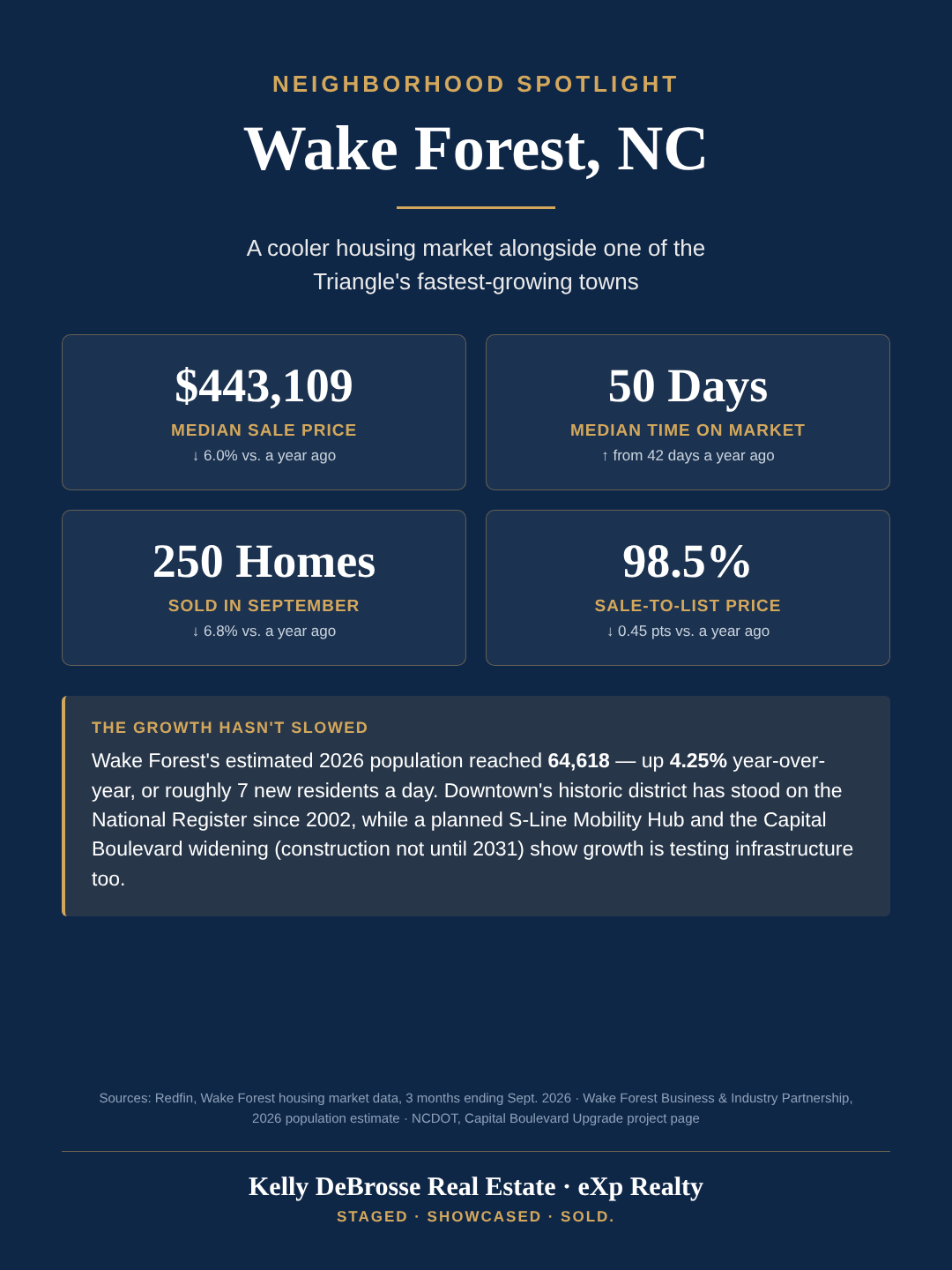
Over the three months ending in September 2026, the median sale price in Wake Forest was $443,109, down 6.0% compared to the same period a year earlier, according to Redfin. Homes are also taking a bit longer to sell: the median over those same three months was 50 days on market, up from 42 days a year ago. Sales volume was down too — 250 homes sold in September versus 268 the year before, a 6.8% drop.
One number that barely moved: sale-to-list price. Homes that sold went for 98.5% of asking on average, only 0.45 percentage points lower than a year ago. In plain terms, well-priced homes in Wake Forest are still selling close to what sellers ask for — buyers just have a little more time and a little more leverage than they did last year.
Why the town keeps growing anyway
None of that softening has slowed Wake Forest’s population growth. The town’s Business & Industry Partnership estimated the 2026 population at 64,618, up 4.25% from 2025 — roughly seven new residents a day, by the group’s count, and enough to keep Wake Forest among the fastest-growing municipalities in the state.
Historic downtown, modern growing pains
Part of the draw is the walkable downtown itself. The Downtown Wake Forest Historic District has been listed on the National Register of Historic Places since February 2002, and its brick storefronts — most built between 1890 and 1949 — still house the shops and restaurants that give the town its small-town feel.
Keeping that feel while the population grows is the town’s real balancing act. On the transit side, the Federal Railroad Administration released $57.9 million this spring toward design of the S-Line passenger rail corridor, which includes a planned downtown Mobility Hub estimated at roughly $50 million to build — NCDOT has applied for an additional $31.25 million federal grant to help fund it. Grade-separation construction is already underway where the rail line crosses Durant Road, and at Rogers Road the utility work came first: crews started in September, and NCDOT expects the grade-separation project itself to begin in earnest by January 2027.
The bigger relief valve for day-to-day traffic, though, is still years out. NCDOT’s plan to widen Capital Boulevard into a six-lane controlled-access highway between Raleigh and Wake Forest is in the right-of-way acquisition phase now, with construction on the first segments not scheduled to begin until 2031 and the northern segments not until 2033.
What it means if you’re looking at Wake Forest
For buyers, this is a window where a slower market and steady sale-to-list pricing can work in your favor, especially if you’re patient about the search. For sellers, pricing realistically still matters — the data shows homes that are priced right keep selling close to asking, even as the overall market has cooled from a year ago. And for anyone weighing the town’s long-term growth story against its current traffic headaches, it helps to know both are real: the growth isn’t slowing, and the biggest infrastructure fix isn’t arriving overnight.
If you have questions about what’s happening in Wake Forest or any other corner of the Triangle, I’m always happy to talk through what the numbers mean for your specific situation.
Thinking about your own situation?
Call or text, or send me an email. We can start with a conversation.